
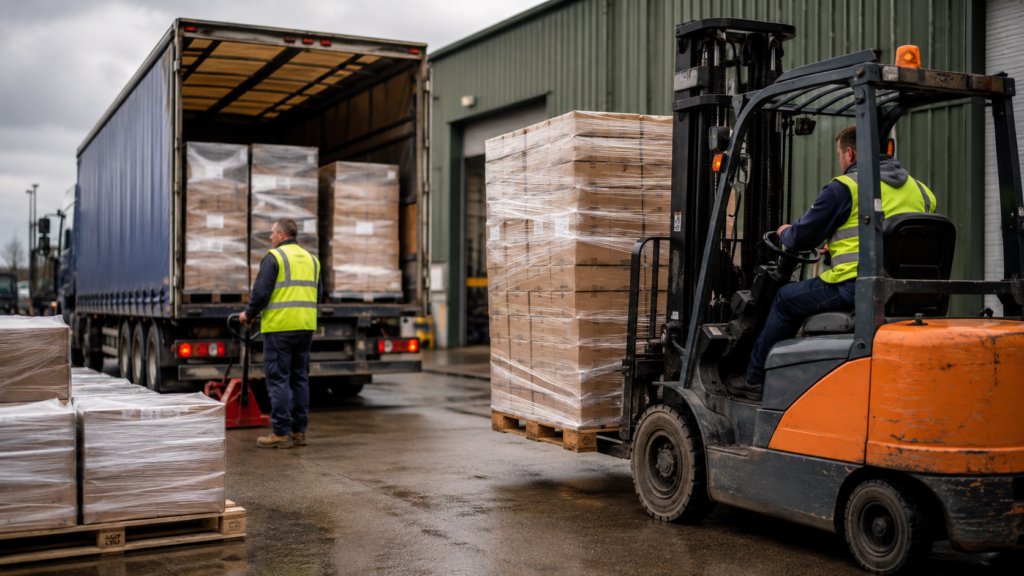
If you need to move goods that are too big or too heavy for a standard parcel courier, pallet delivery is almost always the answer. It’s the safest, most costeffective way to transport freight across the UK but for firsttime shippers, the process, sizes and options can feel unfamiliar.
This guide is your starting point. It explains what pallet delivery is, walks you through how the process works from booking to delivery, and shows you how to prepare your goods and choose the right courier. Along the way, we link out to more detailed guides on specific topics sizes, costs, delivery speeds and more so you can go deeper wherever you need to.
What Are UK Pallet Delivery Services?
Pallet delivery is a freight service that transports goods stacked and secured on a wooden or plastic pallet, rather than as individual parcels. Because the goods travel as a single, stable unit that can be moved by forklift or pallet truck, palletising is the standard way to send anything heavy, bulky, or made up of many items at once.
It’s used across almost every industry manufacturing, wholesale, retail, construction, engineering and eCommerce as well as by individuals sending larger oneoff items. The appeal comes down to safety (goods are consolidated and secured, not handled loose), efficiency (a full pallet moves in one action) and cost (one pallet is far cheaper than its contents sent as separate parcels).
Most UK pallet deliveries run through pallet networks collaborative groups of regional hauliers that pool their coverage so goods can be collected locally, consolidated at a central hub, and delivered nationwide, usually the next working day. This network model is what makes fast, affordable, countrywide pallet delivery possible.
How Does Pallet Delivery Work?
From your first booking to the final signature, palletised freight follows a clear, repeatable process.
- Booking your shipment. You provide the details of your consignment the number of pallets, their size and weight, the collection and delivery postcodes, and the service speed you need. Accurate measurements and weights matter here, because they determine both the price and the vehicle sent.
- Pallet collection. On the agreed day, a vehicle arrives to collect your pallet. Depending on your site, this may use your own forklift, or a vehicle fitted with a tail lift and pallet truck so the driver can lower the goods safely. Your pallet should be fully loaded, wrapped and labelled before collection.
- Transport through the network. Your pallet goes to the haulier’s local depot, then trunks overnight to a central hub, where pallets from across the country are sorted onto vehicles heading to the right region. Barcode scanning tracks its progress at every step. This hubandspoke system is why a pallet collected in one county can reach almost any other the following day.
- Final delivery. The pallet moves to a depot near the delivery address for its final leg, is unloaded by forklift or tail lift, and a proof of delivery is captured. With a modern provider, you can follow the whole journey through an online tracking portal. Like hackling transport company in Gloucestershire
Pallet Sizes and Weight Limits
Pallet loads are usually described as quarter, half or full terms that refer to the height of the loaded goods rather than the base, which stays at the UK standard footprint of 1200mm x 1000mm. Each height band has its own weight limit, and larger loads that overhang the edges or exceed the limits are classed as oversized. Limits vary between networks, so always check before booking.
Choosing the right size is the single biggest factor in your price and whether your goods are accepted. For a full breakdown of each pallet type, its dimensions and weight capacity, see our detailed guide to standard UK pallet sizes and weight limits.
What Can Be Sent on a Pallet?
Almost anything that can be stacked and secured within the pallet footprint travels well by pallet retail stock, manufacturing parts, construction materials, industrial goods and carefully packaged fragile items. Regulated or hazardous goods (classed under ADR rules) need a suitably accredited carrier, and most couriers publish a list of prohibited or restricted items.
To check whether your goods are suitable and what’s offlimits, read our guide to what can and can’t be sent on a pallet.
Delivery Speed Options
Pallet networks offer a range of service speeds so you can balance cost against urgency from economy (the cheapest, with a slightly longer transit time) through nextday and timed deliveries to same-day for the most urgent consignments.
The two most common questions are how the standard service works and when to pay for speed. We cover both in detail in what is next-day pallet delivery and how it works and same-day vs next-day pallet delivery.
What Affects the Cost of Delivery?
Pallet pricing is driven by a handful of clear factors: the pallet size, the weight, the distance between collection and delivery, the service speed, and whether the addresses are commercial or residential. Understanding these helps you keep costs down and avoid surprises.
For a full explanation of pricing and practical ways to cut it see our guides on how much pallet delivery costs in the UK and how businesses reduce shipping costs with palletised delivery. If you’re deciding between delivery to a business or a home address, our guide to residential vs commercial pallet deliveries explains the differences.
How to Prepare a Pallet for Collection
How you prepare your pallet has a direct impact on whether your goods arrive undamaged, on time and without extra charges. A little care here prevents most problems:
- Distribute the load evenly. Stack the heaviest items on the bottom and lighter items on top, keep the weight balanced, and make sure nothing overhangs the pallet edges.
- Wrap and secure it. Use stretch wrap, add strapping for heavier or taller loads, and use corner protectors so the whole thing becomes a single, solid unit that won’t shift in transit.
- Label it clearly. Include the delivery address, contact details and any consignment references, plus handling labels such as “fragile” where relevant.
- Measure and weigh after loading. Include the pallet base itself, round up, and if you’re between two sizes, book the larger one to avoid delays or surcharges.
How to Choose the Right Pallet Delivery Company
Not all pallet couriers are equal. When you’re deciding who to trust with your freight, weigh up:
- Nationwide coverage membership of an established pallet network is a strong sign of genuine countrywide (and often European) reach.
- Tracking realtime visibility from collection to proof of delivery gives valuable peace of mind.
- Insurance check what goods in transit cover is included as standard, and what you can add for higher-value loads.
- Customer support a responsive, knowledgeable team matters most when something needs sorting quickly.
- Delivery performance looks at ontime records, reviews and testimonials, and favours a courier with a long track record.
Ready to Send a Pallet?
Pallet delivery is a safe, efficient and economical way to move heavy and bulky goods anywhere in the UK. Getting it right comes down to preparing your load properly, choosing the right service, and picking a courier you can trust to collect on time and deliver as promised.
At Hacklings transport logistics solution, pallet delivery is what we do best. With over 60 years of experience and as part of the Palletline network, we handle half a million pallets a year through our distribution centres in Bourton-on-the-Water and Swindon, delivering across Gloucestershire, Wiltshire, Berkshire, Oxfordshire and the whole of the UK. Our modern, eco-conscious fleet, real-time tracking and experienced team keep your freight in safe hands from collection to delivery, backed by our own warehousing and storage facilities for your wider logistics needs.
Get in touch for a pallet delivery quote and see how our nationwide collection, secure transport, competitive pricing and flexible delivery options can work for your business.
Frequently Asked Questions
-
What is pallet delivery?
Pallet delivery is a freight service that transports goods stacked and secured on a pallet as a single unit, moved by forklift or pallet truck. It's the standard, cost-effective way to send heavy, bulky or multi-item shipments across the UK, usually via a pallet network.
-
How does pallet delivery work?
You book your consignment with its size, weight and postcodes; the courier collects the prepared pallet; it travels through a network of local depots and a central hub; and it's delivered to the destination with proof of delivery, tracked throughout.
-
Can I track my pallet delivery?
Yes, most modern providers offer real-time online tracking, letting you follow your consignment from collection through each depot to final delivery
-
Do I need a forklift or tail lift?
If you have a forklift on site, loading is straightforward. If not, book a tail-lift service so the driver can raise and lower the pallet safely. Tail lifts often aren't available for oversized pallets.
-
Can individuals book pallet delivery, or is it only for businesses?
Both. While pallet delivery is heavily used by businesses, individuals can also book it to send larger items you just need to prepare and present the pallet correctly.